AI and IoT Trends in 2026: Future Technologies Transforming Life
Last updated: 12 Aug 2026
243 Views
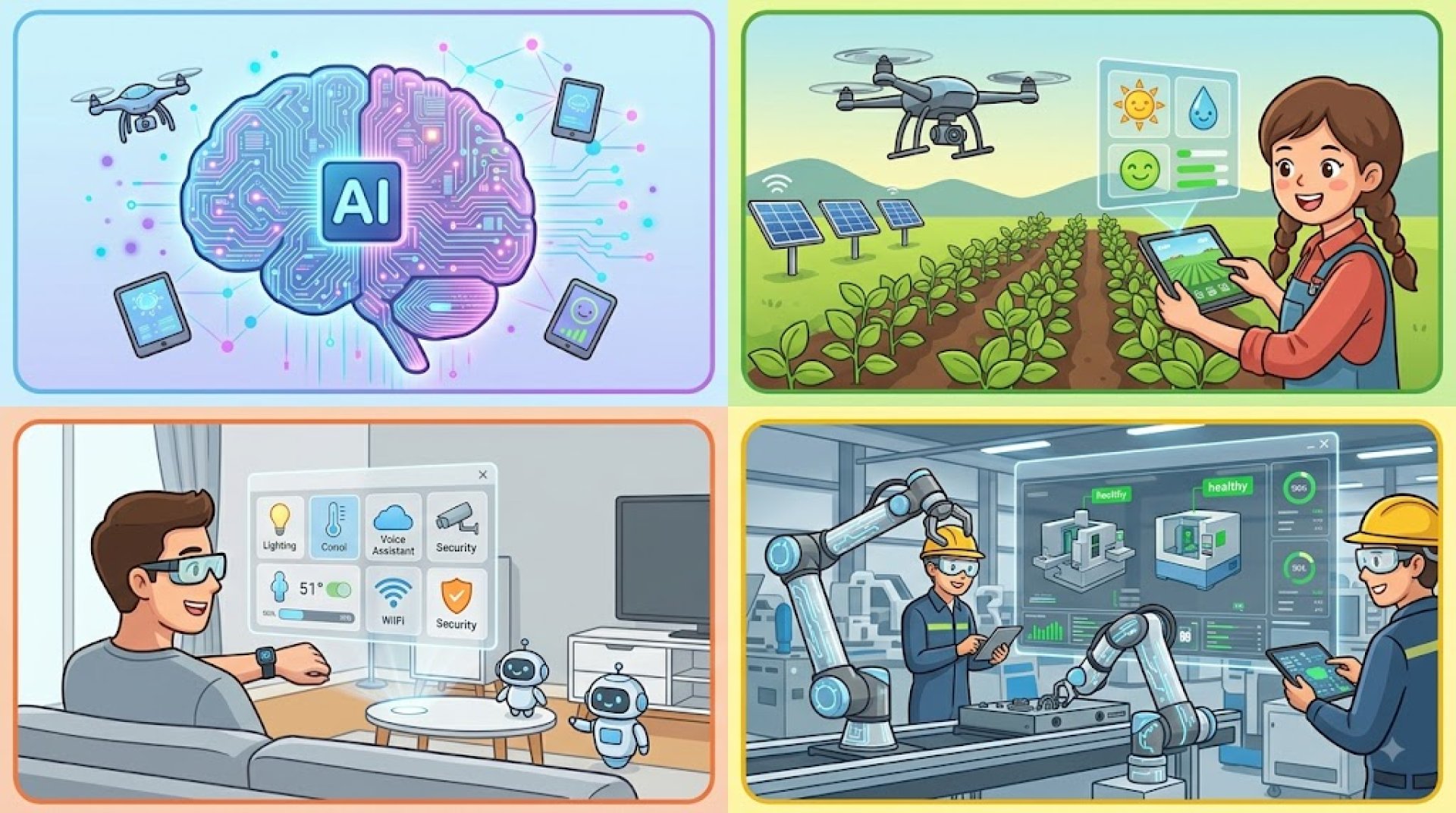
In the fast-evolving digital era, AI (Artificial Intelligence) and IoT (Internet of Things) have become critical drivers of business and daily life. By 2026, the convergence of AI and IoT (AIoT) has transformed from a future concept into an essential part of our routines.

1. Smart Farming & Edge IoT
Modern agriculture has embraced Smart Farming using IoT sensors to monitor soil moisture, temperature, and weather conditions in real-time. AI algorithms process this data to predict yields and optimize resources.
Modern agriculture has embraced Smart Farming using IoT sensors to monitor soil moisture, temperature, and weather conditions in real-time. AI algorithms process this data to predict yields and optimize resources.
- Resource Management: Accurately calculates water, fertilizer, and nutrient requirements to minimize resource waste and excessive chemical usage.
- Smart Agricultural Drones: Works alongside AI to perform aerial crop inspections, identifying plant diseases and pest infestations early.
- Climate Resilience: Helps farmers reduce operational costs, maximize yields, and adapt sustainably to volatile weather conditions.
2. Generative AI & Automation in Daily Life
Smart home devices and wearables in 2026 offer Hyper-Personalization. AI learns user behaviors to automatically adjust home lighting and climate, while wearable sensors monitor vital signs to provide early health alerts.
Smart home devices and wearables in 2026 offer Hyper-Personalization. AI learns user behaviors to automatically adjust home lighting and climate, while wearable sensors monitor vital signs to provide early health alerts.
- Smart Home: Intelligent control systems for lighting, temperature, and security that learn user behaviors to automatically customize the home environment.
- Health-Tracking Wearables: Smartwatches and smart glasses powered by AI to analyze vital signs weekly and provide proactive health alerts.
- Voice Assistants: AI agents that understand natural language context and accurately manage connected IoT devices throughout the house.
3. Industrial IoT (IIoT) & Predictive Maintenance
Factories use Industrial IoT and AI for Predictive Maintenance. Sensors detect machine vibrations and temperatures 24/7, allowing AI to detect anomalies before breakdowns occur, minimizing downtime.
Factories use Industrial IoT and AI for Predictive Maintenance. Sensors detect machine vibrations and temperatures 24/7, allowing AI to detect anomalies before breakdowns occur, minimizing downtime.
- Predictive Maintenance: IoT sensors monitor machine vibrations, heat, and sound 24/7, while AI analyzes equipment health to send early alerts before breakdowns occur.
- Reduce Production Downtime: Prevents unexpected machine halts, reducing repair costs and maximizing overall production efficiency.
- Smart Robotics & Cobots: Works safely alongside humans through high-speed processing and detection systems.
4. Smart City & Sustainability
Smart cities leverage AI and IoT to improve living standards and environmental sustainability.
- Smart Traffic Management: AI cameras analyze traffic density to adjust signals in real-time, reducing congestion.
- Building Energy Management: IoT monitors power usage and optimizes HVAC and lighting to reduce carbon emissions.
- Smart Environmental Monitoring: Smart waste bins alert when full, and sensors track air quality (PM 2.5) citywide.
Summary
The convergence of AI and IoT in 2026 is the foundational core driving the digital economy, smart farming, next-gen industry, and sustainable urban living. Adapting and implementing these technologies appropriately will deliver a true competitive edge for the future.
Related Content

เจาะลึกเทคนิคการใช้ไฟต่อช่วงแสงสำหรับแปลงปลูกพืชเศรษฐกิจ ช่วยแก้ปัญหาแสงแดดน้อย วันฟ้าหลัว และควบคุมระยะเวลาออกดอกได้อย่างแม่นยำ
13 Aug 2026
n the era of Precision Agriculture, the heart of any automated system is undoubtedly the Smart Farm Control Box. It acts as the central brain, processing data and executing commands for irrigation, fertigation, and greenhouse management. However, a common question among beginner farmers and system developers is: Should we choose an industrial-grade PLC (Programmable Logic Controller) or a Microcontroller (such as ESP32 or Arduino)?
This article provides a comprehensive comparison of their pros and cons to help you make the most cost-effective decision for your farm.
13 Oct 2026
Comprehensive guide on Automatic Venturi Fertilizer Injector operating on Bernoulli's principle, mainline sizing calculations, bypass assembly for pressure drop mitigation, and comparison with dosing pumps.
14 Oct 2026
