VFD Smart Farming Water Pump Energy Saving Guide
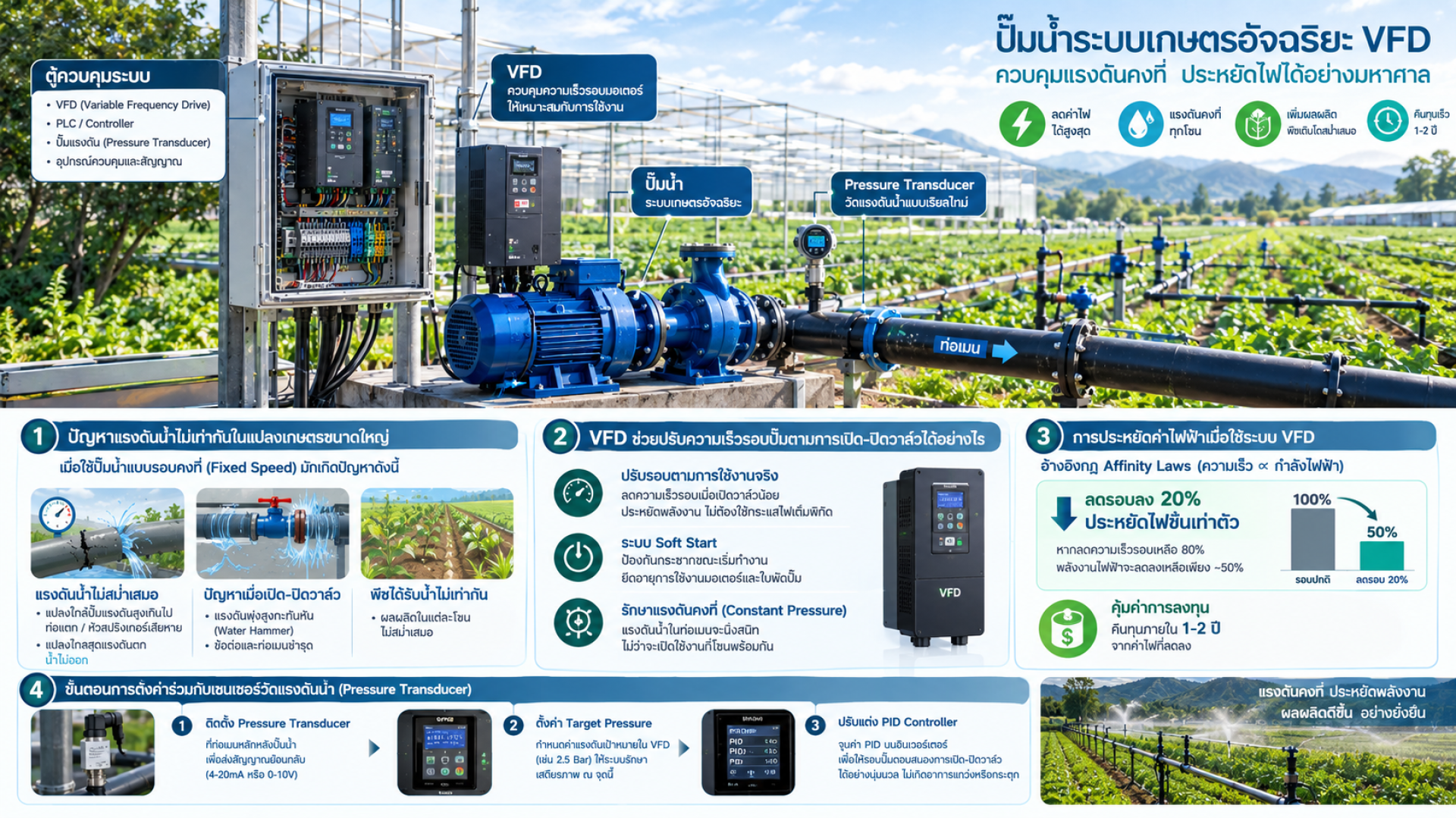
Irrigation systems represent the heart of agricultural operations and consume the highest electrical energy on a farm. Implementing a VFD Smart Farming Water Pump (Variable Frequency Drive) system provides a modern solution that maintains constant water pressure while drastically reducing energy costs.
Uneven Water Pressure Issues in Large-Scale Fields and Their Impact on Crops
In expansive agricultural fields divided into multiple watering zones, using traditional fixed-speed pumps introduces unavoidable operational challenges:
- Inconsistent Water Pressure: Zones closest to the pump suffer from excessive pressure, damaging pipes and sprinkler heads, while far-end zones experience severe pressure drops.
- Water Hammer Problems: Switching zone valves on or off causes sudden pressure surges (Water Hammer) that rupture pipe joints and main pipelines.
- Uneven Crop Growth: Irregular water delivery directly impacts crop development and lowers yield consistency across zones.
How VFD (Variable Frequency Drive) Adjusts Pump Speed Based on Valve Operations
A VFD modulates AC power frequency to automatically control motor rotation speed based on actual demand:
- Speed Adjustment by Demand: When fewer valves are open, the VFD reduces motor speed to maintain constant pressure without running at full power unnecessarily.
- Soft Start Protection: Eliminates power surges during startup, extending motor and pump impeller lifespan significantly.
- Constant Pressure Maintenance: Keeps line pressure rock-solid regardless of how many zones are active simultaneously.
Calculating Energy Savings After Upgrading to VFD Systems
Energy savings from VFDs follow Affinity Laws, where motor speed directly dictates power consumption:
- 20% Speed Reduction Cuts Power by Half: Reducing pump speed to 80% cuts energy consumption down to approximately 50%.
- High Return on Investment: For farms running pumps multiple hours daily, VFD installations typically pay for themselves within 1-2 years through reduced electricity bills.
Setup Procedures for Integrating Pressure Transducer Sensors
To maximize VFD efficiency, configure a closed-loop control system with pressure sensors as follows:
- Install a Pressure Transducer: Mount the pressure sensor on the main pipeline downstream of the pump to feed real-time signals (4-20mA or 0-10V) back to the drive.
- Set Target Pressure: Define the target operating pressure on the VFD (e.g., 2.5 Bar) to keep system pressure stable.
- Tune the PID Controller: Calibrate drive PID parameters for smooth pump acceleration and deceleration, preventing pressure hunting or erratic oscillation.